
Mini 5G Router with Wi-Fi 6 for AGV & Factory IoT
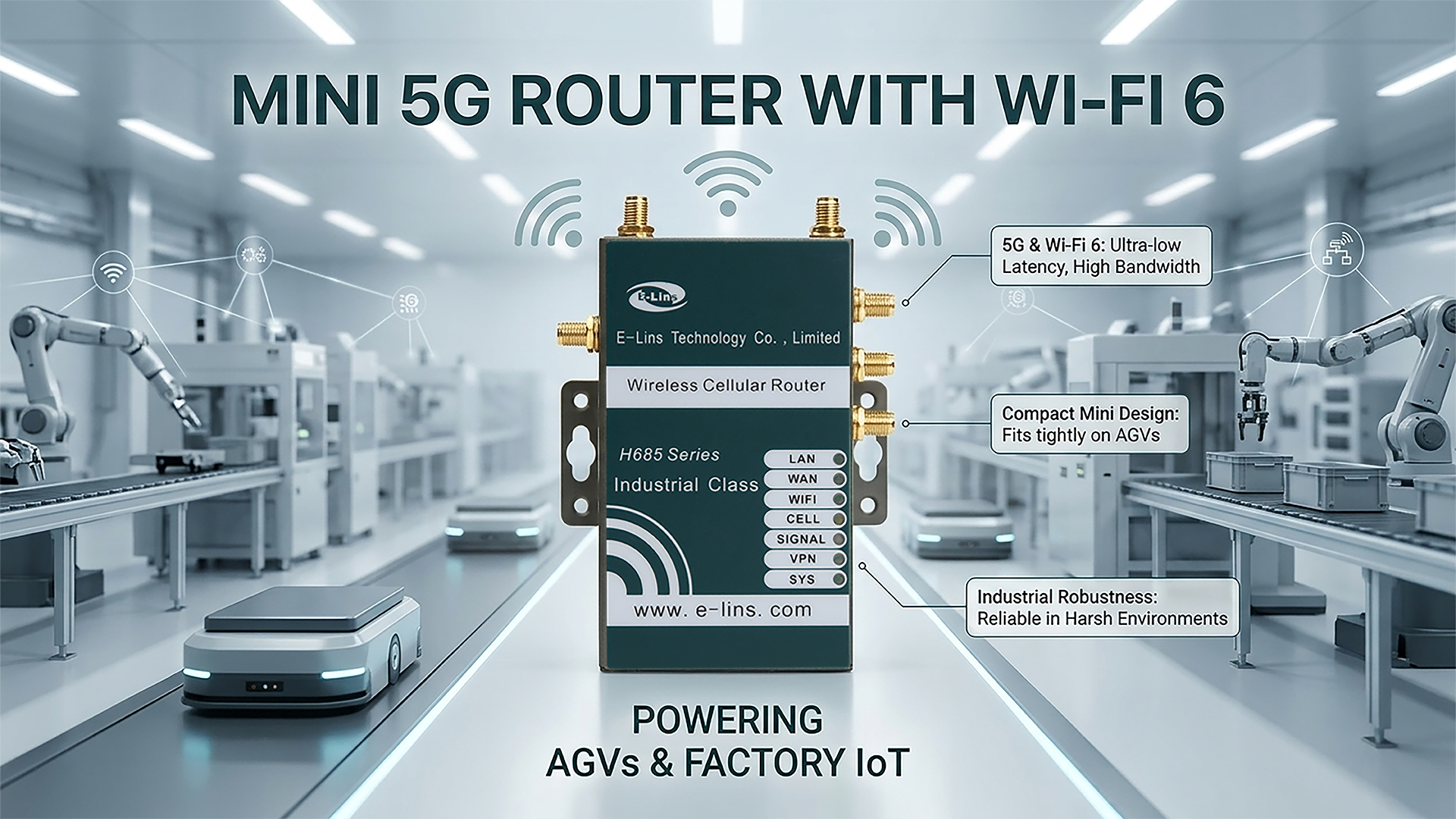
Mini 5G Router with Wi-Fi 6 for AGV and Factory Floor IoT: Why Density Matters More Than Speed
When a router spec sheet lists Wi-Fi 6, the instinct is to read it as a speed upgrade — faster downloads, lower latency, the usual marketing shorthand. On a factory floor running a fleet of AGVs, conveyor sensors, and handheld scanners, that framing misses the point entirely. The problem Wi-Fi 6 actually solves is not how fast one device connects — it is how gracefully thirty devices connect at once, in the same 20-metre radius, without the network falling over. The H685f Wi-Fi 6 variant pairs that capability with 5G cellular backhaul in a super-mini form factor designed to sit on the AGV itself.
What Is a Mini 5G Router with Wi-Fi 6 for AGV Applications?
A mini 5G router with Wi-Fi 6 for AGV is a compact onboard gateway that gives a moving vehicle two network connections at once: a 5G cellular link back to the plant’s central systems or cloud platform, and a high-density local Wi-Fi network for the devices riding along with it or communicating with it nearby — barcode scanners, safety sensors, HMI tablets, and other AGVs in the same zone. The router does not choose between these two roles. It runs both simultaneously, in a housing small enough to mount inside an AGV’s electronics bay.
The Wi-Fi 6 designation refers to the 802.11ax standard, and the distinction from the previous generation (Wi-Fi 5 / 802.11ac) is not primarily about top speed. Wi-Fi 6 introduces OFDMA (Orthogonal Frequency-Division Multiple Access) and improved MU-MIMO, both of which are mechanisms for handling many simultaneous client connections more efficiently. A single AGV moving through a warehouse might pass through Wi-Fi coverage zones shared with twenty other vehicles, each carrying its own onboard devices, plus fixed infrastructure — conveyor controllers, RFID readers, overhead cameras — all contending for the same spectrum. Wi-Fi 5 degrades under that contention. Wi-Fi 6 is designed specifically to not.
The H685f Wi-Fi 6 variant combines this with 5G SA/NSA cellular, automatic 4G fallback, RS232/RS485 serial for legacy controller integration, four DI/DO ports for hardware event handling, and PoE In — all inside the same super-mini alloy housing E-Lins uses across the H685 line. For AGV integrators, the practical result is one device that handles the vehicle’s external connectivity (cellular) and its local wireless environment (Wi-Fi 6) without two separate radios competing for space inside an already-crowded electronics enclosure.
Simple framing: 5G is the AGV’s connection to the outside world — the warehouse management system, the cloud dashboard, remote diagnostics. Wi-Fi 6 is the AGV’s connection to its immediate surroundings — nearby devices, local sensors, other vehicles in the same aisle. A factory floor router needs to do both well, and do the second one well specifically when many other devices are doing the same thing in the same space.
Site Readiness Checklist Before Specifying an AGV Router
AGV and factory floor deployments have a different risk profile from static cabinet installations — the router moves, the RF environment changes constantly, and a configuration that works on the bench may behave differently on the production floor. Confirm the following before specifying hardware.
- How many Wi-Fi client devices will be in range of a single AGV simultaneously — onboard devices, nearby AGVs, and fixed infrastructure access points?
- What is the available mounting space and power rail inside the AGV’s electronics enclosure — voltage range, connector type, available DIN space?
- Does the AGV’s onboard controller communicate over RS232, RS485, or Ethernet, and does the router’s serial configuration match the controller’s baud rate and protocol?
- What is the 5G/4G carrier coverage inside the facility — many factory buildings have significant indoor signal attenuation from metal racking, machinery, and structural steel?
- Are DI/DO ports required for safety interlocks, e-stop status, or bumper sensor integration with the router’s logic?
- What VPN architecture connects the AGV fleet back to the central warehouse management system or fleet controller?
- Has the Wi-Fi channel plan been coordinated with the facility’s existing wireless infrastructure to avoid co-channel interference between AGV routers and fixed access points?
Why Wi-Fi 6 Matters More on the Factory Floor Than the Spec Sheet Suggests
Most discussions of Wi-Fi 6 focus on its headline throughput figures — up to 9.6 Gbps theoretical, compared to Wi-Fi 5’s 3.5 Gbps. For a single AGV transmitting status updates and receiving navigation commands, that throughput difference is irrelevant; the actual data volume per device is small. What changes meaningfully is how the network behaves when dozens of devices are active in the same space at the same time, which is the normal operating condition of a warehouse or production floor, not an edge case.
Wi-Fi 5 networks handle multiple clients through time-division — each device gets a turn to transmit, one at a time, even if its actual data payload is tiny. As client count rises, the overhead of switching between devices starts to dominate, and latency becomes unpredictable. For an AGV relying on low-latency Wi-Fi communication with a safety system or a fleet coordination server, unpredictable latency is not a performance inconvenience — it can mean a navigation command arrives late enough to matter.
OFDMA, the core Wi-Fi 6 mechanism, divides each transmission opportunity into smaller frequency sub-channels that can carry data for multiple devices simultaneously, rather than serialising them. The practical effect for a 5G Wi-Fi 6 router for warehouse automation is that latency stays more consistent as device density increases. A network that handles ten devices smoothly on Wi-Fi 5 might show clear latency degradation by thirty devices; the same network on Wi-Fi 6 shows a much flatter curve.
In a warehouse pilot we supported involving twelve AGVs operating in a shared 800 m² zone, average round-trip latency for fleet coordination messages on the Wi-Fi 5 baseline measured 18 ms with four AGVs active, rising to 61 ms once all twelve were operating simultaneously alongside the facility’s fixed scanner infrastructure — roughly a 3.4x increase. After switching the AGV-mounted routers to the Wi-Fi 6 configuration, the same twelve-vehicle scenario measured 14 ms at four AGVs and 23 ms at full fleet load — under a 1.7x increase, and the absolute figure remained within the fleet controller’s responsiveness threshold throughout. The difference was not in peak throughput; it was in how the network degraded as load increased.
An automotive parts distribution centre was expanding its AGV fleet from eight to twenty-two units across a single facility, and began experiencing intermittent navigation pauses as the fleet grew past roughly fifteen active vehicles — pauses the integrator initially suspected were a fleet management software issue. After analysis, the cause was identified as Wi-Fi contention: the existing onboard routers used Wi-Fi 5, and the aggregate device count in the busiest zones — AGVs, handheld scanners, and fixed RFID readers — had crossed the threshold where time-division overhead started introducing latency spikes during peak shift changes. Replacing the onboard routers with the H685f Wi-Fi 6 variant resolved the navigation pauses without any change to the fleet management software or the facility’s access point layout. The integrator’s project lead described it as “a problem we’d been trying to solve in software for three weeks, fixed by a hardware change that took an afternoon per vehicle.”
Important: Wi-Fi 6’s density benefits depend partly on the access point infrastructure also supporting 802.11ax. If the facility’s fixed access points remain Wi-Fi 5, an AGV-mounted Wi-Fi 6 router will still see improved AGV-to-AGV communication on its own local network, but communication with the facility’s fixed infrastructure will operate at Wi-Fi 5 characteristics until those access points are also upgraded. Plan the Wi-Fi 6 transition with the facility’s network team, not in isolation on the vehicle fleet alone.
Key Features for Mini 5G Wi-Fi 6 Router Selection
An AGV-mounted router operates in one of the most demanding RF and physical environments in industrial IoT — constant motion, dense device populations, vibration, and power systems shared with motors and motor controllers. The specification needs to address the vehicle’s connectivity requirements and the practical constraints of fitting electronics into a mobile platform.
1. Wi-Fi 6 (802.11ax) with Dual-Band Operation
Dual-band Wi-Fi 6 — 2.4 GHz and 5 GHz operating concurrently — gives the AGV flexibility in crowded RF environments. The 2.4 GHz band has better range and wall penetration but more contention from legacy devices; the 5 GHz band has less legacy interference but shorter range. Running both simultaneously allows the router to place different traffic types on whichever band performs better, and provides a fallback if one band becomes congested in a specific zone of the facility.
2. 5G SA/NSA with Automatic 4G LTE Fallback
The cellular link on an AGV typically serves a different purpose than the Wi-Fi link — it connects the vehicle to systems outside the local facility network: cloud-based fleet analytics, remote diagnostics, software updates, or a central warehouse management system hosted off-site. 5G SA/NSA with 4G fallback ensures this connection remains available even in areas of the facility with weaker 5G penetration — common in large steel-frame buildings where indoor 5G coverage can vary significantly between zones.
3. Super-Mini Form Factor for Onboard Integration
AGV electronics bays are not designed around router dimensions — the router has to fit into space left over after motor controllers, battery management systems, navigation sensors, and safety PLCs are accounted for. The H685f’s super-mini alloy housing is sized for exactly this kind of constrained integration, with the same footprint considerations that make it suitable for embedded OEM products generally.
4. RS232/RS485 for AGV Controller Integration
Many AGV navigation controllers, motor drive systems, and onboard PLCs communicate over RS232 or RS485 rather than Ethernet — particularly on AGV platforms that have been in service for several years, where the control architecture predates widespread Ethernet adoption on mobile platforms. The H685f’s serial port allows the router to bridge this serial data into the cellular and Wi-Fi network without an additional protocol converter taking up space in the electronics bay.
“We see two categories of AGV integration request. The first is new-build AGVs where the integrator has full control over the electronics architecture and Ethernet is used throughout — that’s the easier case. The second is retrofitting connectivity onto AGV fleets that are five or eight years old, where the navigation controller talks RS232 and nobody wants to redesign the control board just to add a cellular connection. The serial port on the H685f exists mainly for that second case. It turns a connectivity retrofit into a router swap instead of a controller redesign.”
— E-Lins application engineering team5. DI/DO for Safety and Status Integration
AGVs carry safety-critical signals — emergency stop status, bumper sensor triggers, charging dock contacts, and navigation mode indicators. The four DI/DO ports on the H685f allow these hardware signals to be read directly by the router and reported over the cellular or Wi-Fi connection — for example, transmitting an e-stop event to the fleet controller immediately, independent of whatever the AGV’s main controller is doing at that moment. This does not replace the AGV’s primary safety system, but it adds a secondary reporting path that can be valuable for fleet-wide incident logging and analytics.
6. PoE In for Simplified Vehicle Power Integration
PoE In allows the router to draw its power from a PoE-capable Ethernet connection rather than requiring a separate tap into the AGV’s DC power bus. For integrators adding connectivity to an existing AGV design, this can simplify the wiring change required — particularly where an Ethernet connection to the router is already planned for data purposes, and PoE eliminates the need for an additional power wire run through the vehicle’s cable channels.
7. Wide-Voltage DC Input and Industrial Temperature Range
AGV power systems are typically battery-based, with voltage that varies across the charge cycle — a 24 V nominal system might range from 21 V near depletion to 28 V immediately after charging, with transients during motor start and regenerative braking events. The H685f’s wide-voltage input (5–40 V DC, with a 60 V option) absorbs this variation without an intermediate regulator. The −35 °C to +75 °C operating range covers both cold-storage AGV applications and the heat generated inside a densely packed electronics bay during continuous operation.
E-Lins H685f Wi-Fi 6 Variant: Mini 5G Router for AGV and Industrial IoT
The H685f Wi-Fi 6 variant is built on E-Lins’ established super-mini H685 platform, with the Wi-Fi radio upgraded to 802.11ax dual-band and the cellular module configured for 5G SA/NSA with 4G fallback. The result is a router that addresses both halves of the AGV connectivity problem — external cellular backhaul and local high-density Wi-Fi — in a housing that fits where compact industrial routers are designed to fit.
E-Lins H685f IoT 5G Router with Wi-Fi 6, PoE In and DI/DO
Super-mini industrial 5G SA/NSA router with dual-band Wi-Fi 6 (802.11ax), RS232/RS485 serial, 4× DI/DO, PoE In, wide-voltage DC input, and full VPN suite. Built for AGV, AMR, in-vehicle, and dense industrial IoT deployments requiring both cellular backhaul and high-density local wireless in one compact unit.
What the Wi-Fi 6 Upgrade Changes in Practice
The standard H685f and this Wi-Fi 6 variant share the same cellular module, serial interface, DI/DO configuration, power input range, and enclosure. The difference is entirely in the wireless radio and its protocol capability. For deployments where the router serves a single static device with no nearby wireless contention — a vending machine, a remote sensor station, a kiosk — the Wi-Fi 6 upgrade delivers little practical benefit, and the standard Wi-Fi 5 variant is the more cost-appropriate choice.
The upgrade becomes meaningful specifically when the deployment density crosses a threshold — multiple AGVs in a shared zone, a production cell with many wireless sensors, a vehicle moving through a facility with substantial fixed wireless infrastructure. The E-Lins H685f Wi-Fi 6 variant is positioned for exactly that threshold: not a faster router for a quiet network, but a router designed to maintain performance on a busy one.
The EN 18031 certification is relevant for projects deploying into the EU market, where this standard covers cybersecurity requirements for radio equipment. For AGV fleets that will operate across multiple facilities — including potentially across borders within Europe — having this certification confirmed at the hardware level removes one compliance variable from the project’s regulatory checklist.

E-Lins H685f Wi-Fi 6 variant — super-mini 5G SA/NSA router with dual-band 802.11ax, RS232/RS485, DI/DO, and PoE In for AGV and dense IoT environments
Which Project Structure Suits the H685f Wi-Fi 6 Variant?
The Wi-Fi 6 variant is the right choice when the deployment involves either high local device density, a mobile platform moving through varying RF environments, or both. Where neither applies, the standard Wi-Fi 5 H685f or another model in the line may be more cost-appropriate.
AGV and AMR Fleets
- Onboard router handles cellular backhaul and local Wi-Fi 6.
- Wide-voltage input matches battery-based vehicle power systems.
- RS232/RS485 bridges legacy navigation controllers.
- DI/DO reports e-stop and bumper sensor status to fleet controller.
- Super-mini form factor fits constrained electronics bays.
Dense Production Cell IoT
- Multiple wireless sensors and HMIs in a confined cell.
- Wi-Fi 6 OFDMA maintains latency as sensor count grows.
- RS232 integrates legacy PLC or protocol converter.
- VPN connects the cell to central SCADA or MES platform.
- PoE In simplifies power wiring where Ethernet already runs.
Mobile Command and In-Vehicle Systems
- 5G cellular for vehicle-to-cloud connectivity on the move.
- Wi-Fi 6 serves onboard tablets, scanners, and crew devices.
- Wide-temperature range for vehicle compartment conditions.
- DI/DO for ignition sense and equipment status integration.
- 4G fallback maintains connectivity outside 5G coverage areas.
OEM Embedded Connectivity Modules
- Super-mini size fits inside host product enclosures.
- OEM/ODM customization for firmware and branding.
- EN 18031 certification supports EU market products.
- Serial and DI/DO integrate with host product electronics.
- Wi-Fi 6 future-proofs products for dense deployment environments.
Comparison: Wi-Fi 6 vs Wi-Fi 5 H685f for AGV and IoT Deployments
The Wi-Fi generation is the primary decision point between H685f variants. The table below clarifies when the Wi-Fi 6 upgrade is worth specifying and when it is not.
| Factor | H685f Wi-Fi 6 (802.11ax) | H685f Wi-Fi 5 (802.11ac) |
|---|---|---|
| Best fit | Multiple devices in shared RF space — AGV fleets, dense production cells | Single static device, low local wireless contention |
| Latency under high device density | Remains comparatively stable as device count rises | Degrades more sharply as device count rises |
| Single-device throughput | Higher theoretical ceiling, rarely the binding factor | Adequate for typical IoT and telemetry payloads |
| Facility infrastructure dependency | Full benefit requires Wi-Fi 6 access points nearby | No dependency — works with any Wi-Fi 5/6 infrastructure |
| Cost | Modest premium over Wi-Fi 5 variant | Lower cost where density is not a factor |
| Typical deployment | AGV/AMR, warehouse automation, production cells | Vending, kiosks, remote monitoring, single-vehicle telematics |
Common Mistakes When Deploying Wi-Fi 6 Routers on AGVs
Specifying Wi-Fi 6 Without a Density Problem to Solve
Wi-Fi 6 is sometimes specified by default because it is the newer standard, on deployments where a single AGV with no nearby wireless contention would perform identically on Wi-Fi 5. This is not harmful, but it is an unnecessary cost if the project’s budget would be better spent elsewhere — additional DI/DO modules, a higher PoE budget, or a second unit for a different vehicle. Specify Wi-Fi 6 when device density or RF contention is an identified factor, not as a default upgrade.
Upgrading Vehicle Routers Without Upgrading Facility Access Points
The latency improvements from Wi-Fi 6 are most pronounced when both ends of a communication — the AGV router and the facility’s fixed access points — support 802.11ax. Upgrading only the AGV fleet still improves AGV-to-AGV communication on isolated local networks, but communication with fixed infrastructure that remains on Wi-Fi 5 will not see the full benefit. Coordinate the Wi-Fi generation upgrade across the fleet and the facility infrastructure together where possible.
Testing Cellular Coverage at One Point, Not Along the AGV’s Route
An AGV moves through multiple zones of a facility, and 5G/4G signal strength can vary substantially between them — particularly near loading docks (more open, often better signal) versus deep storage racking (more attenuation from metal shelving and stored goods). A signal test at the AGV’s charging dock does not represent signal conditions along its full operating route. Signal should be logged along the complete route during commissioning, with particular attention to the weakest points, before relying on cellular connectivity for time-sensitive fleet communication.
Ignoring RS232 Configuration Mismatches During Retrofit
When retrofitting connectivity onto an existing AGV fleet, the navigation controller’s serial parameters — baud rate, parity, flow control — are often undocumented or only known by the original AGV manufacturer. Before finalising the H685f’s serial configuration, obtain these parameters directly from the AGV’s technical documentation or by capturing the serial traffic with a protocol analyser. A mismatch here is a common cause of “the router is connected but the AGV isn’t reporting data” issues during retrofit commissioning.
Underestimating Vibration and Connector Stress on Mobile Platforms
A router that performs flawlessly on a test bench can develop intermittent connection issues once mounted on a moving AGV, due to cumulative vibration affecting connector seating — antenna SMA connectors, serial connectors, and power terminals are all susceptible over months of operation. During installation, ensure connectors are properly torqued and consider strain relief on cable runs near the router. This is a mechanical installation detail rather than a router specification issue, but it is one of the more common sources of “intermittent fault, can’t reproduce on the bench” reports on AGV deployments.
Application Scenarios for Mini 5G Wi-Fi 6 Routers
The H685f Wi-Fi 6 variant serves deployments where cellular backhaul and dense local wireless need to coexist on a compact platform. These are the categories where that combination appears most consistently.

AGV and AMR Fleets
Onboard router provides 5G cellular link to the fleet management platform and Wi-Fi 6 for nearby scanners, sensors, and inter-vehicle communication in shared warehouse zones.

Warehouse Automation and Logistics
Sortation systems, conveyor controllers, and pick-to-light stations connected over Wi-Fi 6 in dense zones, with 5G providing site-to-cloud connectivity for warehouse management systems.

Production Cell IoT
Multiple wireless sensors, HMI tablets, and quality inspection devices in a single production cell, sharing Wi-Fi 6 spectrum without latency degradation as device count grows during shift changes.

In-Vehicle and Mobile Command
Delivery vehicles, mobile command units, and field service vans using 5G for cloud connectivity while Wi-Fi 6 serves onboard tablets, scanners, and crew devices simultaneously.

Cold Storage and Specialised Environments
AGVs and fixed IoT devices operating in cold storage facilities benefit from the H685f’s wide operating temperature range alongside Wi-Fi 6’s density handling in compact storage layouts.

OEM Embedded Products
Manufacturers integrating cellular and Wi-Fi 6 connectivity into their own branded products — kiosks, vending platforms, robotics — using the H685f’s OEM/ODM customization and super-mini footprint.
Extended Reading
E-Lins H685f Wi-Fi 6 Product Page — Full specification, images, and ordering information for the mini 5G router with Wi-Fi 6, PoE In, and DI/DO.
IoT 5G Router Category — Browse the complete E-Lins 5G router lineup across compact, standard, and feature-rich configurations.
H820frc 5G RedCap Router with PoE In/Out — For larger cabinet installations needing serial, DI/DO, and bidirectional PoE alongside cellular.
H900f Dual SIM 5G Router — For sites needing dual SIM carrier redundancy and Active PoE Out to downstream devices.
Wi-Fi Alliance — Wi-Fi 6 Overview — Technical background on 802.11ax from the industry body that certifies Wi-Fi standards.
Project Inquiry — Share your AGV fleet size, device density estimate, power system specification, and carrier region for a tailored recommendation.
FAQ
What is the practical difference between Wi-Fi 6 and Wi-Fi 5 for an AGV router?
The main difference is not top-line speed but how the network behaves under high device density. Wi-Fi 6’s OFDMA mechanism allows multiple devices to share transmission opportunities more efficiently, which keeps latency more stable as the number of nearby devices increases — AGVs, sensors, scanners, and fixed access points all contending for the same spectrum. For a single isolated device, Wi-Fi 5 and Wi-Fi 6 perform similarly. For a fleet of AGVs operating in shared zones, Wi-Fi 6 maintains more consistent performance as the fleet grows.
Does the H685f Wi-Fi 6 variant require Wi-Fi 6 access points in the facility to work?
No — the H685f Wi-Fi 6 variant operates with any Wi-Fi infrastructure, including Wi-Fi 5 access points, using backward-compatible 802.11ac/n modes. However, the full density-handling benefit of Wi-Fi 6 is realised when communicating with other Wi-Fi 6 devices, including other AGV-mounted H685f units in the same fleet. Communication with Wi-Fi 5 fixed infrastructure will operate at Wi-Fi 5 characteristics until that infrastructure is also upgraded.
Can the H685f run 5G cellular and Wi-Fi 6 simultaneously without interference?
Yes. The cellular and Wi-Fi radios operate on different frequency bands and are designed to operate concurrently as their primary use case — 5G cellular for WAN backhaul and Wi-Fi 6 for local network access running at the same time is the standard operating mode for this router, not an edge-case configuration. Antenna placement during installation should still follow standard separation guidelines to minimise any near-field interaction between the cellular and Wi-Fi antennas.
What serial protocols does the RS232/RS485 port support for AGV controller integration?
The RS232/RS485 port supports transparent serial-to-IP tunnelling compatible with Modbus RTU, proprietary AGV navigation protocols, and any communication that operates over a standard RS232 or RS485 physical layer. The router does not perform protocol translation beyond serial-to-IP — if the AGV’s fleet management platform expects a specific application-layer protocol (such as Modbus TCP), confirm whether additional middleware is required on the receiving end.
How does the H685f handle the voltage fluctuations of a battery-powered AGV?
The H685f’s wide-voltage DC input (5–40 V standard, 5–60 V option) is designed to absorb the voltage range typical of battery-based systems across their charge cycle, including transients during motor start and regenerative braking. Dual power input with automatic failover also allows a secondary power source to be connected, which can be useful on AGVs with redundant power architectures or battery-swap designs where momentary power gaps occur during swaps.
Is the H685f Wi-Fi 6 variant suitable for cold storage AGV deployments?
Yes. The −35 °C to +75 °C operating temperature range covers typical cold storage facility temperatures, which commonly operate between −25 °C and −18 °C for frozen storage. Confirm that any external antennas and connectors used are also rated for the cold storage environment, as antenna cable flexibility and connector seal materials can be affected by sustained sub-zero temperatures differently than the router’s main enclosure.
What is EN 18031 and why does it matter for this router?
EN 18031 is a European cybersecurity standard for radio equipment, covering requirements for network security, personal data protection, and protection from fraud for connected devices. For AGV fleets or IoT products being deployed or sold in the EU market, hardware that carries this certification at the component level simplifies the overall product or deployment’s regulatory compliance assessment, since the cellular and Wi-Fi radio module’s security baseline is already addressed.
Can the H685f be used for a single static IoT device, or is it only suitable for AGVs?
The H685f Wi-Fi 6 variant works perfectly well for static deployments — it is not AGV-exclusive hardware. However, for a single static device with no nearby wireless device density, the Wi-Fi 6 capability provides limited additional benefit over the Wi-Fi 5 variant, and the cost difference may not be justified. The Wi-Fi 6 variant is recommended specifically where device density, mobility through varying RF environments, or both are present in the deployment.
How many AGVs or devices can realistically share Wi-Fi 6 spectrum in one zone?
This depends heavily on the specific RF environment, access point density, channel width configuration, and the data volume each device transmits. As a general indication from field deployments, Wi-Fi 6 networks have demonstrated stable performance handling two to three times the device density that caused noticeable latency degradation on equivalent Wi-Fi 5 networks in the same space — but this is not a fixed multiplier and should be validated through site testing for any specific facility, particularly one with unusual RF characteristics such as extensive metal racking or reinforced concrete structures.
Does upgrading to Wi-Fi 6 require new antennas?
The H685f Wi-Fi 6 variant ships with antennas appropriate for its Wi-Fi 6 radio configuration. If retrofitting onto an AGV that previously used a Wi-Fi 5 H685f, confirm whether the existing antenna mounting positions and cable types are compatible — in most cases standard dual-band Wi-Fi antennas with appropriate connectors will function correctly across both Wi-Fi generations, but verifying frequency range coverage (particularly for 5 GHz band support if the previous antennas were 2.4 GHz only) before installation avoids a mismatch discovered during commissioning.
Conclusion: Specify for the Network You Actually Have, Not the One on the Datasheet
The case for a mini 5G router with Wi-Fi 6 for AGV deployments is not about chasing the newer wireless standard for its own sake. It is about recognising that the RF environment a router actually operates in — a warehouse floor with a growing AGV fleet, a production cell with dozens of wireless sensors, a vehicle moving through zones of varying device density — behaves differently from the quiet, single-device environment most Wi-Fi performance figures are measured in. Wi-Fi 6’s value is concentrated precisely in the gap between those two pictures.
The E-Lins H685f Wi-Fi 6 variant pairs that density-handling capability with 5G cellular backhaul, RS232/RS485 for legacy controller integration, DI/DO for safety and status signals, and a super-mini form factor designed for the constrained electronics bays of AGVs and similar mobile platforms. For fleets that have already grown past the point where Wi-Fi 5 performance starts to degrade — or that are planned to grow there — the upgrade addresses a problem that tends to appear gradually and then suddenly, as the twelfth or fifteenth vehicle joins a shared zone.
Before specifying the H685f Wi-Fi 6 variant for an AGV or dense IoT deployment, confirm the following:
- Estimate peak device density in the busiest shared zones — not average fleet size, but the worst-case simultaneous device count during shift changes or peak operations.
- Coordinate the Wi-Fi generation upgrade with the facility’s fixed access point infrastructure to realise the full benefit of Wi-Fi 6 on both ends of the connection.
- Obtain and verify serial communication parameters from the AGV’s existing navigation controller before commissioning, particularly on retrofit projects.
Scaling an AGV Fleet and Hitting a Wireless Ceiling?
Tell E-Lins your fleet size, device density, AGV power system, and carrier region. We will confirm whether the H685f Wi-Fi 6 variant fits or recommend the right configuration for your specific deployment.
Contact Us