
5G RedCap: The Consumer Connectivity Revolution
While industries get excited about sensors and slices, the most palpable impact of 5G RedCap for most people will be on their wrists, in their cars, and in their homes. RedCap is poised to solve the fundamental dilemma of connected consumer devices: how to add always-on, reliable cellular connectivity without killing the form factor or the battery.
1)The Smartwatch Dilemma, Solved.
Today’s premium cellular smartwatches are engineering marvels, but they make compromises. They either use power-hungry LTE modems (leading to “charge every night” anxiety) or rely on a Bluetooth tether to your phone, which defeats the purpose of having cellular for a run or swim. RedCap changes the game.
2)A RedCap-enabled smartwatch can:
- Maintain a direct, native 5G connection to the network for calls, streams, and alerts.
- Use significantly less power than an LTE modem, potentially enabling multi-day battery life even with cellular active.
- Be smaller and lighter due to simpler RF and antenna design.
- Offer higher data speeds for faster music/podcast downloads or video calls.
This finally makes the “untethered” promise a practical, all-day reality.
3)Augmented & Virtual Reality: Cutting the Cord for Good
The dream of lightweight, ubiquitous AR glasses is hampered by the need for processing power and battery. One solution is to offload computation to a phone or the cloud. RedCap provides the perfect wireless link for this. It can stream high-definition, low-latency AR overlays to glasses without the need for a bulky, hot, and expensive full 5G modem inside the frame. This could be the catalyst for consumer AR, enabling everything from immersive navigation to real-time translation.
4)The Rise of the “Lite” 5G Smartphone and Broadband
RedCap will also redefine the mid-to-low-tier smartphone and FWA (Fixed Wireless Access) markets. For emerging markets, a “5G Lite” smartphone with a RedCap modem can deliver a solid 100+ Mbps experience at a price point comparable to 4G phones, accelerating the global transition to 5G networks.
Similarly, for home broadband, a RedCap CPE (Customer Premises Equipment) can provide a cost-effective, 100+ Mbps wireless internet solution for less demanding households or as a reliable failover line for businesses, expanding the reach of 5G FWA.
5)Connected Vehicles: Beyond Telematics
While advanced autonomous driving will use full 5G or even direct C-V2X, RedCap is ideal for many in-vehicle infotainment and telematics functions. From streaming HD video to rear-seat entertainment, to collecting and transmitting rich diagnostic and usage-based insurance data, RedCap provides a balanced, cost-effective data pipe for OEMs.
6)A Seamless Consumer Experience
For consumers, the magic will be invisible. They won’t see “RedCap.” They will experience:
- Wearables that last days on a charge with full connectivity.
- AR experiences that are truly mobile and social.
- Affordable 5G devices that work brilliantly.
- More connected “things” in their lives—from pet trackers to e-bikes—that are reliable and long-lasting.
7)FAQ about 5G RedCap
1. What is 5G RedCap?
5G RedCap (Reduced Capability) is a standardized feature within 3GPP Release 17 that defines a new class of 5G devices with reduced complexity, cost, and power consumption compared to enhanced Mobile Broadband (eMBB) devices. It’s designed for mid-tier IoT and industrial use cases that don’t require the full performance of standard 5G.
2. What are the key technical reductions in 5G RedCap devices?
RedCap devices feature reductions in several areas, including: lower maximum bandwidth (e.g., 20MHz in FR1, 100MHz in mmWave), fewer MIMO layers (often 1×1 or 2×2), support for half-duplex FDD, a reduced number of antenna branches, and lower order modulation (e.g., 64-QAM instead of 256-QAM). These simplifications lead to cheaper, less complex modems.
3. What are the main use cases for 5G RedCap?
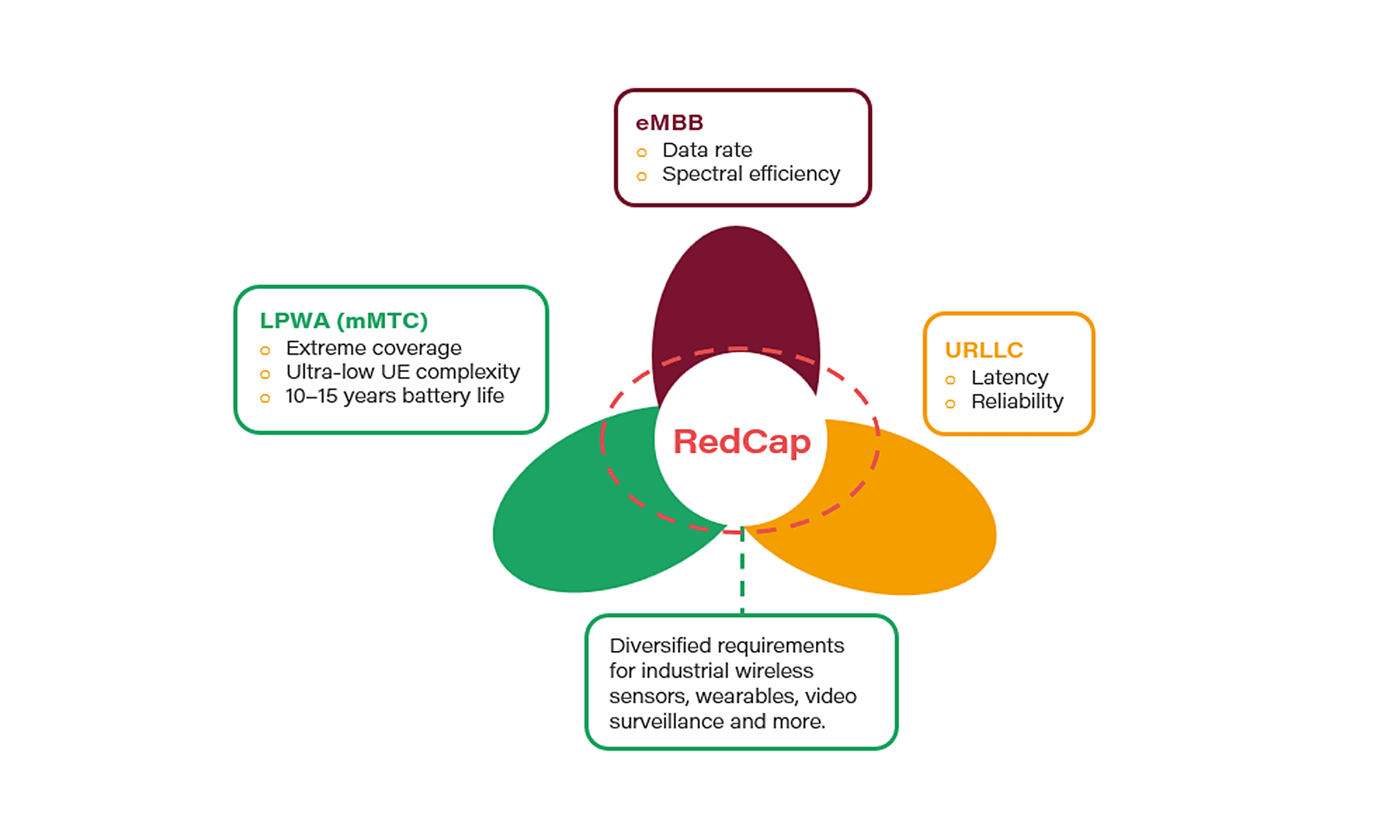
Primary use cases include: Industrial Wireless Sensor Networks (IWSN), video surveillance (with mid-tier cameras), wearables (like advanced smartwatches or AR glasses), and low-end Fixed Wireless Access (FWA) CPEs. It fills the gap between high-end eMBB/low-latency URLLC and low-power massive IoT (NB-IoT/LTE-M).
4. How does 5G RedCap differ from LTE Cat-1/Cat-1bis and LTE-M/NB-IoT?
5G RedCap offers higher data rates (e.g., ~100-200 Mbps downlink) and lower latency than LTE-M/NB-IoT, making it suitable for more demanding applications. Compared to LTE Cat-1, it provides native 5G advantages like network slicing, improved efficiency, lower latency, and a migration path within the 5G ecosystem, though at a potentially higher initial cost.
5. What is a 5G RedCap Router?
A 5G RedCap Router is a gateway or Customer Premise Equipment (CPE) device that incorporates a 5G RedCap module as its cellular modem. It provides connectivity (e.g., Wi-Fi, Ethernet) for multiple local devices by routing their data traffic over a 5G network, but it is built with a cost- and power-optimized RedCap chipset.
6. When would I choose a RedCap Router over a standard 5G Router?
Choose a RedCap Router for applications where cost, device size, or power consumption are critical, and the full performance (e.g., multi-gigabit speeds, ultra-low latency) of a premium 5G router is not required. Examples include cost-sensitive SOHO FWA, secondary backup links for SMEs, connectivity for mid-rate IIoT gateways, or temporary event networks.
7. Can a 5G RedCap device connect to any 5G network?
Yes, 5G RedCap is a 3GPP standard, so RedCap devices are designed to operate on public 5G networks that support the required functionalities (based on Release 17 and beyond). However, network operators must enable RedCap support in their core network and radio access network (RAN). Initial deployments are focused on 5G Standalone (SA) networks.
8. What are the power consumption benefits of 5G RedCap?
By simplifying the modem’s RF components, processing requirements, and supporting enhanced power-saving features (like eDRX and longer sleep cycles), RedCap devices can achieve significantly lower power consumption than full-featured 5G devices. This is crucial for battery-powered devices like wearables and sensors.
9. Does 5G RedCap support advanced 5G features like network slicing?
Yes, a key advantage of 5G RedCap over LTE alternatives is its native integration into the 5G system architecture. This means it can support core 5G features like network slicing, which allows operators to create virtual networks tailored for specific IoT application requirements (e.g., guaranteed bandwidth for surveillance).
10. Is 5G RedCap available now? When will it be widely deployed?
Commercial RedCap modules and devices started becoming available in 2024. Widespread network support and device availability are expected to ramp up through 2025 and 2026, as operators with mature 5G SA networks upgrade their software and device ecosystems expand. The rollout pace varies by region and operator.
RedCap, by making 5G affordable and efficient, will weave connectivity into the fabric of our daily lives more deeply and seamlessly than ever before. It transitions 5G from a premium smartphone feature into a ubiquitous utility for all our devices.
Search for 5G RedCap Routers? Consider E-Lins, China Best 5G RedCap Router Manufacturer, providing many excellent RedCap Routers for your potential cases.