
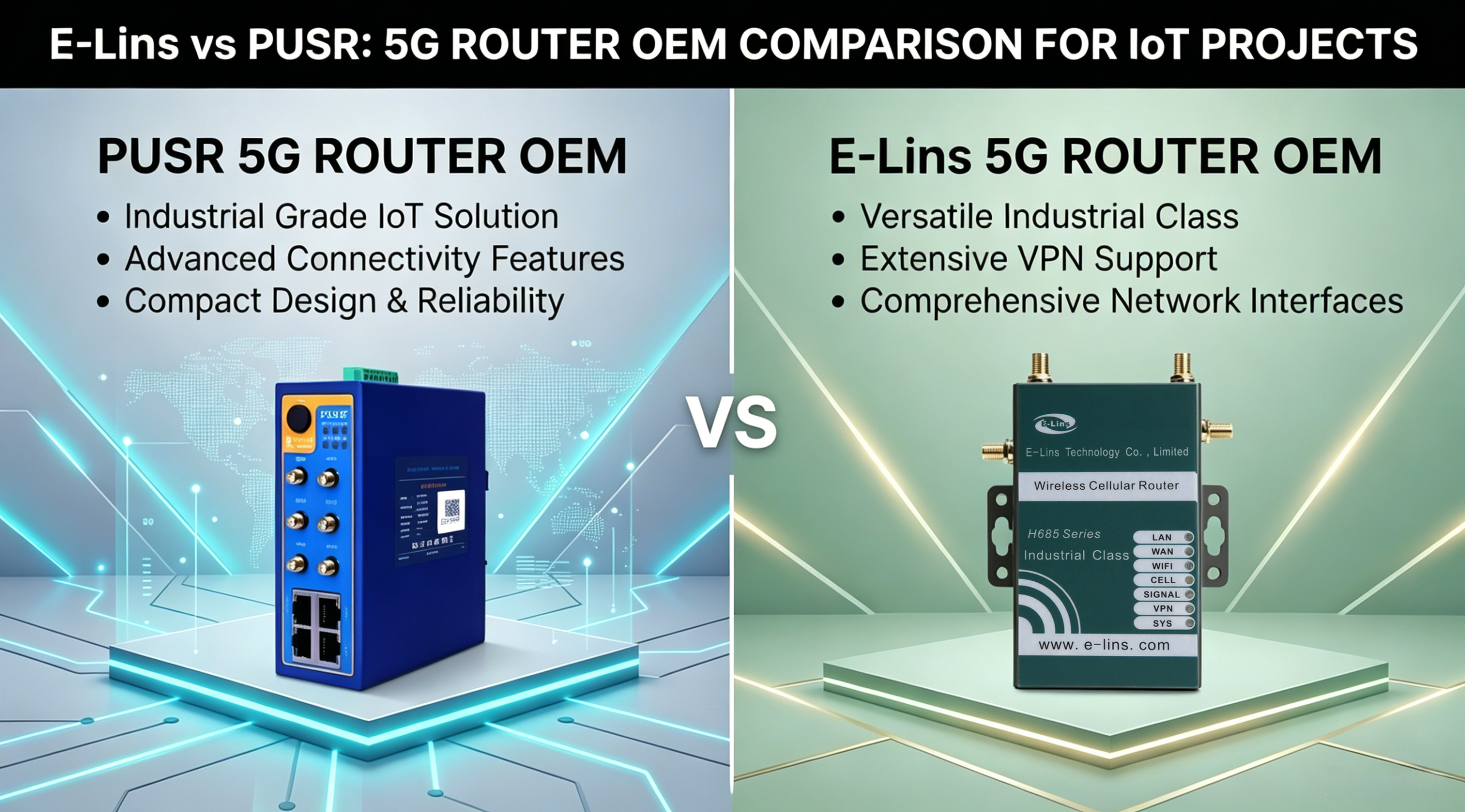
Why This Comparison Is Worth Writing
When someone searches for E-Lins vs PUSR industrial router comparison, they are usually an engineer or procurement manager who has already shortlisted both brands and wants one clear tiebreaker. In my experience running product evaluations across distributed IoT deployments in Asia, the Middle East, and Europe, both E-Lins and PUSR appear on shortlists for similar reasons — they are both Chinese manufacturers offering industrial-grade cellular routers at price points that undercut European alternatives, both have manufacturing certifications, and both claim broad VPN and management capability.
But the two companies have built their businesses around meaningfully different buyer profiles, and once you understand that distinction, the choice becomes considerably less ambiguous. PUSR (Jinan USR IOT Technology) has built a reputation as one of China’s highest-volume industrial IoT device suppliers — ranked first in China’s industrial IoT gateway online sales for seven consecutive years according to a 2023 Frost & Sullivan survey — with a product line that emphasises affordability, quick deployment, and a broad catalogue spanning everything from serial-to-Ethernet converters to edge computing gateways. E-Lins Technology has taken a narrower, deeper path: fewer product categories, but a security and customisation stack on their cellular router platform that targets the OEM, enterprise security, and 5G-first buyer more specifically.
A note on which models I’m comparing: PUSR’s catalogue is large. For this comparison I’ve focused on their two most relevant cellular router models for projects that sit at the intersection of IoT and enterprise connectivity — the USR-G816w (5G multi-port industrial router, Qualcomm X62 modem) and the USR-G806s (4G LTE with RS485 serial and GPS). On the E-Lins side: the H685f (compact 5G with full security stack, Wi-Fi 6 option, serial, DI/DO) and the H900frc (5G RedCap for private network IoT at scale). These four models represent the realistic alternatives that buyers encounter when evaluating both brands for the same project.

E-Lins H685f — super-mini 5G router with enterprise security stack and OEM/ODM support
Project Requirements Checklist: Answer These Before Picking a Brand
These eight questions consistently produce a clearer answer than any number of spec-sheet comparisons. Work through them before reading further — you may find the choice is already made.
- Do you need 5G today, or will 4G LTE serve the project for the next three to five years? This determines which models are in scope from each manufacturer immediately.
- Is your project deploying on a private 5G campus network? 5G RedCap compatibility with private 5G core infrastructure is a specific requirement that narrows the field significantly.
- Does your project require OEM or ODM customisation — branded firmware, custom hardware configuration, or integration as a component inside your own product? The depth of each manufacturer’s OEM program varies significantly.
- Do field devices in your deployment communicate over RS232 or RS485 serial? Not all 5G models in either lineup include native serial; this can be a project-defining constraint on some models.
- Is RADIUS or TACACS+ centralised authentication a compliance requirement? Authentication architecture depth differs materially between platforms.
- What is the DC power rail voltage at your installation locations? 24V, 48V, and wider ranges matter when no additional converter is available in the cabinet.
- How many nodes will this deployment reach at full scale, and what is your management platform strategy? Cloud platform fee structures and management depth vary between manufacturers.
- What certifications are required for your target market — CE, FCC, EN 18031, IATF16949? Both manufacturers hold industrial certifications, but specific standards vary by product line.
Understanding the Two Manufacturers
PUSR (Jinan USR IOT Technology) — China’s High-Volume IoT Device Specialist

PUSR operates two self-owned manufacturing facilities, both certified to ISO 45001 and IATF 16949 — the automotive-grade quality management standard that signals serious manufacturing discipline. The company’s claim to being ranked first in China’s industrial IoT gateway online sales for seven consecutive years is not an empty marketing statement; it reflects a product strategy built around volume, breadth, and approachability. Their catalogue stretches from a basic $88 USR-G805 4G mini router through to the $440 USR-G816w 5G flagship and the USR-M300 edge computing gateway, with serial device servers, LoRa modems, and industrial Ethernet switches filling the gaps in between.
What PUSR does particularly well is the breadth-plus-affordability combination. An integrator who needs a specific serial-to-Ethernet converter for a niche industrial protocol, a compact 4G router for a vending machine fleet, and a 5G gateway for a smart city pilot can source all three from a single PUSR catalogue. The USR Cloud platform handles remote management across the fleet. Their EN 18031 cybersecurity certification on multiple products demonstrates that they take EU market compliance seriously. And for buyers who want a simple, plug-and-play router that is reliable and economical — the G805 and G806 series have strong track records.
The honest limitations on the PUSR side: their security stack depth, particularly in centralised authentication and zone-based access control, is more consistent with a commercial-grade product than an enterprise or OT-compliance-grade one. Their OEM program exists (ODM and EMS services are listed as a business line) but is not published with the same specificity of program terms as E-Lins’ OEM offering. And on the 5G side, the USR-G816w is a capable device, but the PUSR 5G lineup is still developing compared to the breadth of their 4G portfolio.
E-Lins Technology — The Shenzhen OEM Platform With Enterprise Security Depth
E-Lins is a smaller, more focused manufacturer. Their product catalogue is narrower than PUSR’s — they make cellular routers and related connectivity hardware, not the full span of IoT devices that PUSR covers. What they have invested in instead is depth: the security and management stack across their router platform is unusually complete for the price tier. The H685f and H900frc share a platform that includes RADIUS and TACACS+ centralised authentication with full accounting, 802.1x port security, a zone-based object firewall, the complete VPN suite including DMVPN and WireGuard, and cloud NMS management at no recurring per-device license fee.
The OEM and ODM program is an explicit commercial offering at E-Lins — not a capability that exists but isn’t discussed. Manufacturers building connected equipment who want 5G cellular as an embedded, branded component of their own product have a documented path to do that with E-Lins, including custom firmware builds, branding suppression, and hardware configuration flexibility. The H685f’s super-mini form factor (100×60×21 mm) exists specifically to serve that OEM embedding use case. And the H900frc’s 5G RedCap capability is the only device in this comparison specifically designed for private 5G campus deployments at IoT endpoint scale.
“The question I get most often from buyers who’ve shortlisted both brands is: ‘Which one is more reliable?’ In my experience, that’s the wrong question to be leading with. Both manufacture to reasonable industrial standards. The more useful question is: ‘Which one was designed for buyers with requirements like mine?’ PUSR was designed for volume buyers who need a reliable, affordable, quickly deployable router. E-Lins was designed for OEM manufacturers, enterprise OT security requirements, and 5G-first deployments. Those aren’t the same buyer.”
— E-Lins Application Engineering, on the PUSR comparison contextFive Dimensions Where the Two Manufacturers Diverge
1. OEM / ODM Depth: Component Supplier vs Product Supplier
This is the dimension that matters most for a specific category of buyer — equipment manufacturers who are not sourcing a router to install as infrastructure, but a cellular connectivity module to embed inside their own branded product. If you are building a connected industrial machine, a smart energy meter, or an automated inspection system that needs 5G cellular as a built-in feature under your own brand name, the OEM relationship with your router supplier is as important as the router’s technical specifications.
OEM 5G router manufacturer with custom firmware branding is a search that leads to E-Lins specifically because their OEM program is explicit: custom firmware UI, third-party brand suppression, hardware configuration selection from a published option set, and an engineering engagement to integrate with the customer’s cloud platform. The H685f’s super-mini form factor — smaller than most industrial DIN-rail routers — exists because OEM customers need the router to fit inside an enclosure that was designed around their product, not the router.
PUSR lists ODM and EMS (Electronics Manufacturing Services) as business offerings. They have the manufacturing capability to support OEM work. What is less published is the program specifics: minimum volumes, firmware customisation scope, and the engagement model for a manufacturer who wants to suppress the PUSR brand from their product’s firmware entirely. For buyers who need a clear, documented OEM path before committing to a vendor relationship, the E-Lins program is more explicitly defined.
A Taiwanese energy management equipment manufacturer was developing a new generation of three-phase smart meters with built-in cellular data reporting. Their requirement: 5G connectivity embedded in the meter housing, reporting to their proprietary SCADA cloud under their own brand with no third-party router UI visible to meter operators or end customers.
Their evaluation included both PUSR and E-Lins. The PUSR USR-G816w had the 5G capability they needed, but the firmware branding customisation requirement — eliminating all third-party branding from the management interface — was not available through PUSR’s standard commercial program within the project timeline. E-Lins’ OEM program addressed this directly: a custom firmware build that surfaced the manufacturer’s own brand in all user-facing screens and connected to their cloud API was completed as part of the engagement. The meter product launched with the H685f as its embedded connectivity module, completely invisible as a third-party component to the end customer. “Our customers think we built the cellular connectivity ourselves,” the manufacturer’s product director told me afterward. “That was exactly what we needed.”
2. Enterprise Security Stack: Depth Matters for OT Compliance
Factory automation, energy infrastructure, and water utility networks increasingly face security compliance requirements — IEC 62443, local grid codes, and internal IT security baselines that OT teams are now required to meet following a wave of industrial ransomware incidents over the past four years. The router connecting field devices to cellular WAN is a critical enforcement point for those requirements, and the security architecture on the router needs to match what the compliance framework actually specifies.
The E-Lins H685f and H900frc include RADIUS TACACS+ 802.1x zone-based firewall industrial IoT router — the specific combination that maps to IEC 62443 SL-2 access control and audit requirements. RADIUS and TACACS+ provide centralised authentication with full accounting (who accessed which device, when, what they changed). 802.1x prevents any unauthorised device from joining the LAN port without completing an EAP authentication handshake. The zone-based object firewall segments the OT network into named zones — field device zone, SCADA zone, WAN zone — with inter-zone rules that are more maintainable and auditable than raw iptables ACLs.
PUSR’s security features — across the USR-G816w and USR-G806s — include a stateful firewall, NAT, DMZ, port forwarding, VPN encryption (IPsec, OpenVPN, PPTP, L2TP, GRE), and the EN 18031 EU cybersecurity certification on qualifying products. This is a solid commercial-grade security baseline. What it does not include is the centralised RADIUS/TACACS+ authentication with accounting, the 802.1x port-level access control, or the zone-based firewall abstraction that the E-Lins platform provides. For deployments where security compliance is primarily about VPN encryption and basic access control, PUSR’s feature set is adequate. For deployments subject to IEC 62443 or equivalent frameworks, the E-Lins security depth is the relevant specification.
During a water treatment authority evaluation across 32 remote pump stations requiring centralised RADIUS authentication on all management interfaces, I compared the configuration workflow between the PUSR USR-G806s and the E-Lins H685f. The G806s does not include native RADIUS management authentication support in its current firmware — authentication is via local username/password only, which meant the authority’s compliance requirement for centralised credential management could not be met on that device without a workaround.
The H685f’s RADIUS configuration was completed through its Security → AAA module in the web UI, with parameters for primary and backup RADIUS servers, shared secret, and accounting logging. Average configuration time per device for a technician familiar with neither platform: approximately 8 minutes. The outcome: the H685f met the authority’s compliance requirement natively; the G806s required a change of specification to continue in the evaluation.
3. 5G Architecture: Public Carrier vs Private Network vs RedCap
Both manufacturers have 5G products, but they approach the 5G landscape from different positions. PUSR’s USR-G816w uses the Qualcomm X62 modem — the same modem core used in Peplink’s BR1 Mini 5G — and supports 5G SA/NSA with 4G fallback, dual SIM, and Wi-Fi 5. It is a solid full-5G device for public carrier deployments where throughput ceiling and LTE fallback capability are the primary metrics.
E-Lins covers both full 5G (H685f, 5G SA/NSA) and 5G RedCap (H900frc). The 5G RedCap router for private 5G campus IoT deployment use case is one that PUSR does not have a direct equivalent for in their current lineup. RedCap (3GPP Release 17 NR-Light) connects to 5G SA core networks — accessing 5G network slicing and 5G QoS — at a reduced modem cost and power draw compared to full 5G. For private 5G deployments where a manufacturer is deploying 50 to 500 endpoint nodes across a production facility and device cost per unit matters at that scale, RedCap is a meaningful specification. For public carrier deployments where a single router connects a field site to whatever network the carrier provides, the RedCap vs full 5G distinction matters less.
4. Power Input Range: The Specification That Surprises People On-Site
The E-Lins H685f accepts 5–40V DC as standard (with a 5–60V option), with dual power inputs and automatic failover between them. This range covers 12V vehicle/UPS power, 24V industrial control panel standard, 48V telecom-derived DC bus, and battery systems across their charge/discharge voltage range. The H900frc similarly supports wide DC input.
The PUSR USR-G816w accepts 9–36V DC. The USR-G806s accepts 5–35V DC. Both cover 12V and 24V comfortably. The G816w’s 9–36V range also accommodates some 24V industrial bus variations with margin. What neither reaches is 48V DC — a supply voltage that appears regularly in telecom power equipment rooms, rail traction auxiliary systems, and distributed control architectures in process industries. For deployments in those environments, an intermediate DC-DC converter becomes a required accessory rather than an optional one. It is not a disqualifying limitation, but it is a project cost and complexity variable that deserves to be in the specification review before hardware is ordered.
5. Cloud Management Platform: Fee Structure and Feature Depth
PUSR offers the USR Cloud DM platform for remote device management — configuration, firmware updates, monitoring, and remote access to device web interfaces. The platform supports batch management across large device fleets, which is genuinely useful for PUSR’s target buyer managing hundreds of G806 or G805 units. The fee structure is worth understanding before committing to a large deployment: PUSR’s cloud platform has subscription tiers, and the per-device or per-fleet cost at scale should be calculated in advance rather than discovered in year two.
E-Lins’ cloud NMS is included without a recurring per-device license fee. Multi-site monitoring, OTA firmware updates, cell signal status, batch configuration push, and uptime alerting are part of the product. The NMS also provides a secure tunnel link between the cloud platform and deployed routers, enabling one-click access to the router’s web UI and SSH terminal without requiring public IP addresses on field devices. The platform does not yet have the full depth of established enterprise NMS platforms, but for the majority of industrial IoT fleet management tasks, the included functionality is sufficient and the absence of recurring per-device fees is a meaningful TCO consideration at scale.
A utilities integrator was deploying cellular connectivity across 200 distribution transformer monitoring units across a regional power grid. The specification required 4G LTE cellular (5G coverage was not available at all sites), RS485 Modbus RTU for the transformer monitoring instruments, remote firmware management, and a total deployment budget that made per-unit router cost a genuine constraint.
The evaluation shortlisted the PUSR USR-G806s and the E-Lins H685f. Both had RS485 serial. The G806s was priced lower per unit and had solid 4G performance. The decision ultimately came down to two factors: the integrator’s client required centralised RADIUS authentication for all management interfaces as part of their grid security standard, and they wanted the router to be presented as a white-label component under the integrator’s own brand in the management portal, without exposing the underlying manufacturer.
The G806s did not support native RADIUS management authentication, and PUSR’s ODM firmware branding program had a minimum volume threshold that this 200-unit project did not reach. The H685f met both requirements through its standard platform and the E-Lins OEM program. The integrator completed the 200-unit deployment in eight weeks. “The two things that made the difference had nothing to do with cellular performance,” the project lead told me. “They were the security audit checkbox and the brand question. Everything else was comparable.”
Detailed Specification Comparison: E-Lins vs PUSR
The table below compares the four models most commonly evaluated in cross-brand comparisons between these manufacturers, based on published datasheets and product pages verified as of 2024–2025. Notes in the table add context where the raw spec requires it.
| Specification | E-Lins H685f 5G Compact + Security |
E-Lins H900frc 5G RedCap IoT |
PUSR USR-G816w 5G Multi-Port |
PUSR USR-G806s 4G LTE + Serial |
|---|---|---|---|---|
| Cellular Generation | 5G SA/NSA+ 4G/3G/2G fallback; H685f Wi-Fi 6 variant available | 5G RedCap (NR-Light, Rel.17)~150 Mbps DL; 5G SA core + network slicing | 5G SA/NSAQualcomm X62; + LTE Cat 20 fallback; dual SIM | 4G LTE Cat 4150 Mbps DL / 50 Mbps UL; 3G/2G fallback |
| SIM Slots | Single SIMDual SIM available on other H685 variants | Single SIMIoT endpoint model | Dual SIMAuto-failover between carriers | Single SIM |
| Ethernet Ports | 2× Gigabit (WAN + LAN) | Gigabit LAN/WAN | 4× Gigabit1× WAN (configurable as LAN) + 3× LAN | 3× (1 WAN + 2 LAN)10/100 Mbps Fast Ethernet |
| Wi-Fi | Wi-Fi 6 (802.11ax) optionDual-band 2.4 + 5 GHz; standard Wi-Fi 5 variant also available | Optional | Wi-Fi 5 (802.11ac Wave 2)Dual-band 2.4 + 5.8 GHz; up to 867 Mbps; MU-MIMO; AP/STA/repeater | Wi-Fi 4 (802.11b/g/n)2.4 GHz; up to 300 Mbps |
| RS232 / RS485 | RS232 + RS485Serial-to-IP tunneling; Modbus RTU bridge; native hardware | Build option | Not includedNo native serial on USR-G816w; USB port available for adapter | RS485 built-inModbus RTU gateway; transparent mode; GPS also included |
| Digital I/O | 4× DI/DOConfigurable; event-triggered SMS/VPN/NMS alert actions | Build option | Not available | Not available |
| GPS / GNSS | Optional add-on | Optional add-on | Not included | Built-in GPSUseful for fleet and field asset tracking applications |
| Power Input | 5–40V DC (5–60V option)Dual input with auto-failover; covers 12V, 24V, 48V DC rails natively | Wide DC input5–40V standard | 9–36V DCCovers 12V and 24V; 48V requires external converter | 5–35V DCCovers 12V and 24V well |
| PoE Input | IEEE 802.3af/at PD (build option)Standard-compliant; any PoE switch works without adapter | Build option | Not specified as 802.3af/at | Not available |
| Operating Temp | −35°C to +75°C | −35°C to +75°C | −35°C to +75°C | −40°C to +75°CSlightly wider cold range |
| Authentication | RADIUS + TACACS+ + 802.1xFull AAA with accounting; zone-based object firewall; per-client filtering | RADIUS + TACACS+ + 802.1x | Local auth; basic firewallNo published RADIUS/TACACS+ management auth; EN 18031 certified | Local authNo RADIUS/TACACS+ management auth in standard firmware |
| Firewall | Zone-based object firewallIP/FQDN/MAC host objects; per-client web + IP filtering | Zone-based object firewall | Stateful SPI; NAT; DMZ; port forwarding; access restriction | Stateful SPI; NAT; DMZ; port forwarding |
| VPN Protocols | IPsec, L2TP, GRE, OpenVPN, WireGuard, DMVPN, ZeroTier, EoIP, PPTP | IPsec, L2TP, OpenVPN, WireGuard, DMVPN, ZeroTier, GRE | OpenVPN (enhanced), IPsec, PPTP, L2TPNo WireGuard or DMVPN published on G816w | OpenVPN, IPsec, PPTP, L2TP, GRE3× simultaneous OpenVPN clients; also OpenVPN server |
| Routing Protocols | OSPF, BGP, RIP, VRRP, Policy routing | OSPF, BGP, RIP, VRRP | Static routing; DDNS; ICMP keepalive | Static routing; DDNSNo published OSPF/BGP on G806s |
| WAN Failover | Cellular + Ethernet WAN + Wi-Fi WANThree-path failover; LCP + ICMP monitoring; load balancing | Cellular + Ethernet WAN | Cellular + Ethernet + Wi-FiThree-mode automated failover/failback | Cellular + Ethernet WAN |
| Remote Management | E-Lins NMS (no per-device recurring fee)TR-069, SNMP v1/v2c/v3, SMS, Web GUI, SSH/CLI; secure tunnel for remote web access | E-Lins NMS; TR-069; SNMP; SMS | USR Cloud DM PlatformBatch management; remote web access; subscription tiers apply | USR Cloud DM PlatformSame platform; mobile app access; subscription applies |
| Industrial Protocols | Modbus TCP/RTU bridge (via serial); MQTT; SNMP | MQTT; SNMP | Modbus RTU-to-TCP gateway; MQTT; transparent TCP/UDP | Modbus RTU gateway; MQTT; transparent TCP/UDP; JSON reporting |
| OEM / ODM | Explicit published OEM programCustom firmware branding; brand suppression; hardware config flexibility; OEM supply partnership | OEM/ODM supported | ODM / EMS listed as serviceProgram details not fully published; volume minimums apply | ODM / EMS availableSame caveat as G816w — program terms less explicit |
| Form Factor | Super-mini (100×60×21 mm)Smallest 5G industrial router for OEM embedding | Compact IoT endpoint | Standard (approx. 140×100×30 mm)Standard DIN-rail form; not OEM-embedding oriented | Compact (70×86×25 mm)Smaller than G816w; DIN-rail + wall + desktop |
| Certifications | CE; industrial grade; EN 18031 (select variants)ISP carrier deployments: Vodafone, TATA, EE, O2, Reliance | CE; industrial grade | CE; FCC (in progress); WEEE; RoHS; EN 18031 (select products)IATF16949 manufacturing certification | CE; FCC; RoHSISO 9001 quality system |
| Private 5G / RedCap | H685f: full 5G SA/NSA for private or public carrier | 5G RedCap — purpose-designed for private 5G IoT at scaleLower power; lower per-module cost; 5G SA core access | Full 5G — primarily public carrier orientedNo RedCap model in current lineup | 4G LTE — no 5G capability |
* Specifications from manufacturer product pages and datasheets, 2024–2025. Verify with the current SKU before procurement as configurations vary within model families.
Project Selection Guide
Choose E-Lins (H685f or H900frc) When…
- Your project requires OEM embedding in a branded product and you need a documented firmware customisation and brand suppression path from the router manufacturer.
- RADIUS or TACACS+ centralised authentication with full accounting is a compliance requirement — IEC 62443, grid security standards, or internal OT security policy.
- 802.1x port-level access control is needed to prevent unauthorised device connections to the LAN side of the router.
- The deployment is on a private 5G campus network where 5G RedCap endpoint cost and power draw matter at scale (H900frc).
- The installation power rail is 48V DC — the H685f’s 5–40V (60V option) input covers this natively without an additional converter.
- The router needs to serve both RS232/RS485 serial integration and 5G cellular backhaul in a single compact device (H685f).
- DI/DO ports for hardware event reporting — alarm monitoring, e-stop status, limit switch feedback — are required alongside cellular connectivity.
Choose PUSR (USR-G816w or USR-G806s) When…
- Your project needs a high-volume, cost-effective 5G router for public carrier deployments where dual SIM failover and four Gigabit ports are the primary hardware requirements (USR-G816w).
- The application requires 4G LTE with built-in GPS and RS485 serial in a compact, economically priced device — the G806s covers this combination well.
- You are sourcing from a single manufacturer across multiple IoT device categories — serial servers, switches, modems, and cellular routers — and consolidating supplier relationships matters.
- The deployment is on a simple, consistent PPTP/L2TP/OpenVPN VPN architecture and does not require WireGuard, DMVPN, or advanced routing protocol support.
- Security requirements are commercial-grade (basic VPN, stateful firewall, EN 18031 for EU market compliance) rather than OT-compliance-grade (centralised auth, 802.1x, zone-based segmentation).
- The deployment uses a 9–36V DC power supply and PoE compliance to IEEE 802.3af/at is not a specification requirement.
Three Project Experiences That Shaped My Thinking on This Comparison
A precision agriculture integrator was connecting 320 soil moisture and weather monitoring stations across a grain-growing region. Power was solar with 12V battery storage. The cellular requirement was 4G LTE — 5G coverage was not available at most sites. The router needed to be affordable at scale, reliable in outdoor cabinet conditions (−20°C to +60°C seasonal range), and manageable remotely without dedicated network staff at each site. Serial communication was not required — all sensors connected via Ethernet.
For this project, the PUSR USR-G806w (their 4G router with enhanced Wi-Fi) was the correct specification. The E-Lins H685f’s 5G capability was unnecessary cost overhead for a project where 5G was not available or required. PUSR’s volume pricing, the USR Cloud platform’s batch management, and the G806w’s 12V DC compatibility made it the right tool for what this project actually needed. I want to be clear about that — the comparison is not a case for always choosing E-Lins. At 4G scale, with simple connectivity requirements and no OEM embedding or compliance authentication requirements, PUSR is a strong choice.
A gas distribution utility was replacing 4G routers across 58 pressure monitoring and SCADA remote terminal units following a cybersecurity audit that identified inadequate management authentication as a finding. The audit specified that all router management interfaces must authenticate against a central RADIUS server, all management access must be logged for audit, and no engineer access must be possible with a local-only credential after the remediation project was complete.
The existing routers — a mix of PUSR G806s and a competing Chinese brand — could not meet the RADIUS management authentication requirement without firmware updates that the manufacturers indicated were not on the roadmap for those models. Both the E-Lins H685f and the Teltonika RUT956 met the RADIUS/TACACS+ requirement. The H685f was selected on the basis of its simpler RADIUS configuration workflow and its DI/DO capability for integrating the pressure relief valve status signals that the audit had also flagged as requiring cellular reporting. The utility’s IT security manager told me: “We needed a specific compliance checkbox, and the H685f checked it out of the box. That was the whole conversation.”
A Korean port terminal operator was deploying a private 5G network across a container handling facility as part of a smart port initiative — connecting AGVs, crane controllers, and cargo tracking sensors to a central operations platform. Device count at full build-out: approximately 180 endpoint nodes. The private 5G infrastructure vendor confirmed 5G RedCap support on their core network configuration.
The evaluation compared the PUSR USR-G816w (full 5G) and the E-Lins H900frc (5G RedCap) for the endpoint role. The G816w’s dual SIM and four Gigabit ports were more capability than a single-endpoint AGV or sensor node needed. The H900frc’s RedCap specification aligned with the private network infrastructure, and its lower per-module cost across 180 units was a meaningful project budget variable. The port operator deployed H900frc units across the endpoint fleet, with two H685f units at each of the six terminal gate complexes serving as RS232 gateway routers for legacy access control systems. “The private 5G vendor was the one who told us to look at RedCap,” the terminal’s IT director said. “It wasn’t something we would have found on our own.”
Use-Case Fit: Which Device Belongs Where

OEM Embedded Connectivity Products
Super-mini form factor, explicit OEM firmware branding program, 5G SA/NSA. For manufacturers embedding cellular connectivity inside their own branded industrial products with full brand control.

OT Security Compliance Deployments
RADIUS/TACACS+ auth with accounting, 802.1x, zone-based firewall. IEC 62443-aligned. For SCADA, utility, and industrial deployments subject to security audit requirements on router management access.

Private 5G Campus IoT at Scale
5G RedCap for private network deployments. Lower per-module cost, lower power draw, 5G SA core access with network slicing. No direct PUSR equivalent in current lineup.

Public Carrier 5G with Dual SIM
Full 5G SA/NSA, dual SIM carrier failover, four Gigabit Ethernet ports, Wi-Fi 5. Best for multi-device aggregation nodes, surveillance hubs, or 5G sites where throughput and port count are the primary specs.

4G + RS485 + GPS Field Deployments
The G806s uniquely combines RS485 serial, built-in GPS, 4G LTE, and compact size. For fleet tracking, field instrument data collection, and environmental monitoring where 5G is not available and GPS is needed.

High-Volume 4G IoT Sensor Networks
When 4G is sufficient, device count is high, and per-unit cost is the primary variable. PUSR’s volume pricing, broad catalogue, and USR Cloud management make them the competitive choice at this scale.
Common Mistakes in E-Lins vs PUSR Evaluations
Treating “5G” as a Single Specification Across Both Brands
When you compare the PUSR USR-G816w’s 5G (Qualcomm X62, full 5G SA/NSA, dual SIM) with the E-Lins H900frc’s 5G (RedCap, NR-Light, single SIM), you are comparing two meaningfully different things. The G816w’s full 5G modem reaches higher theoretical throughput but costs more per unit and draws more power. The H900frc’s RedCap modem costs less per unit, draws less power, and is specifically designed for private 5G deployments — but it is not a substitute for full 5G where throughput ceiling or dual SIM carrier failover are genuine requirements. The “5G” checkbox on a spec sheet does not tell you which of these you are getting.
Assuming PUSR’s ODM Service Covers Firmware Branding
PUSR lists ODM and EMS as commercial offerings. This covers hardware manufacturing customisation and electronics assembly. What is less clear from published materials is whether firmware-level branding — suppressing PUSR’s brand from the device management UI entirely and replacing it with a customer’s own brand — is within the scope of their ODM program at the volumes typical of IoT project deployments rather than high-volume consumer electronics contracts. Before committing to PUSR for an OEM embedding project that requires firmware-level brand control, get explicit written confirmation of what the ODM program covers and what volumes are required.
Overlooking the PUSR G816w’s Missing Serial Port
The USR-G816w is PUSR’s 5G flagship. It does not include a native RS232 or RS485 serial port. This is the same omission that catches buyers off guard on Teltonika’s RUTX50 — the 5G flagship assumes all field devices are Ethernet-capable, which is an assumption that fails frequently in retrofit and legacy integration projects. If your project requires 5G and serial in the same device, the G816w requires an external USB-to-serial adapter workaround, while the E-Lins H685f includes both natively.
Not Calculating the Cloud Platform Fee at Fleet Scale
The USR Cloud platform has subscription pricing. For a ten-unit deployment the cost is negligible. For a 200-unit deployment managed over three years, the cumulative subscription cost is a project budget line item that belongs in the initial procurement analysis. I have seen projects where the total cloud platform cost over five years exceeded the original hardware cost of the fleet. This is not an argument against USR Cloud — it is an argument for including the cost in the total cost of ownership calculation from the start.
One more thing worth saying plainly: both E-Lins and PUSR are legitimate manufacturers with real-world deployment track records. This comparison is not intended to suggest otherwise. The point is that they have built their products and programs around different buyer profiles, and the right choice between them depends on matching your project’s actual requirements to the manufacturer who designed for buyers like you — not on which brand has better marketing or which product appears first in a search result.
Extended Reading
E-Lins H685f 5G Industrial Router — Full specifications, product gallery, and OEM/ODM enquiry for the super-mini 5G router with Wi-Fi 6 option, RS232/RS485, DI/DO, and enterprise security stack.
E-Lins H900frc 5G RedCap IoT Router — Specifications and OEM program details for the 5G RedCap router designed for private 5G campus IoT deployments at scale.
E-Lins 5G Industrial Router Range — Full lineup of 5G industrial routers from E-Lins across compact indoor, outdoor CPE, and vehicle-mounted configurations.
PUSR USR-G816w 5G Multi-Port Industrial Router — Official PUSR product page for the USR-G816w 5G router with dual SIM and four Gigabit Ethernet ports.
PUSR USR-G806s 4G Industrial Router with RS485 — Official PUSR product page for the G806s with RS485 serial, built-in GPS, and OpenVPN/IPsec support.
E-Lins Project Enquiry — Share your application type, OEM requirements, interface needs, and deployment region for a direct recommendation.
Frequently Asked Questions
What is the main difference between E-Lins and PUSR as OEM router manufacturers?
The core difference is the depth and explicitness of their OEM programs. E-Lins’ OEM/ODM offering is a published commercial program with defined scope: custom firmware branding, third-party brand suppression, hardware configuration flexibility, and an engineering engagement for cloud API integration. This is designed for manufacturers who need the router to be completely invisible as a third-party component inside their own branded product. PUSR lists ODM and EMS services as business capabilities, but the program specifics — particularly firmware-level branding and the volume requirements for accessing those capabilities — are less publicly defined. If firmware-level OEM customisation for a product-embedding use case is a requirement, E-Lins’ program is more directly applicable. If the OEM requirement is primarily a hardware sourcing question (who makes the router, volume pricing, supply reliability), both manufacturers can serve that need.
Does the PUSR USR-G816w support RS232 or RS485 serial integration?
The USR-G816w does not include a native RS232 or RS485 serial port. It has a USB 2.0 port that can support a USB-to-serial adapter as a workaround, but this is not a native hardware interface and introduces the driver compatibility and physical reliability limitations that adapter-based serial integration brings. The PUSR model that does include native RS485 serial is the USR-G806s — a 4G LTE device, not 5G. If your project requires 5G cellular and native RS232/RS485 serial integration in a single device, the E-Lins H685f addresses this combination directly. This is the same gap that exists between the Teltonika RUTX50 (5G, no serial) and the RUT956 (4G, RS232/RS485) — it seems to be a common design trade-off in 5G flagship routers that prioritises throughput and port count over field IO interfaces.
Can PUSR routers support RADIUS authentication for management access?
Based on published firmware documentation for the USR-G816w and USR-G806s, native RADIUS authentication for router management access is not a listed feature on these models. Authentication is via local username and password. This is adequate for many commercial deployments where centralised credential management is not a compliance requirement. For projects subject to security standards that require centralised authentication with accounting — IEC 62443 SL-2, NERC CIP, or internal OT security policies — the E-Lins H685f and H900frc both support RADIUS and TACACS+ authentication with full accounting natively. If RADIUS management authentication is a hard requirement for your project, confirm with PUSR whether their current firmware roadmap includes it before committing to a PUSR-based deployment.
Is E-Lins 5G RedCap (H900frc) directly comparable to PUSR’s full 5G USR-G816w?
They deliver 5G connectivity through different standards and for different deployment contexts, so “comparable” depends on what you’re optimising for. The USR-G816w uses a full 5G NR modem (Qualcomm X62) capable of throughput well above 1 Gbps theoretical, with dual SIM and LTE Cat 20 fallback — optimised for public carrier deployments where throughput headroom and carrier redundancy are primary metrics. The H900frc uses a 5G RedCap (NR-Light, 3GPP Release 17) modem with a peak of approximately 150 Mbps, lower power draw, and lower module cost — optimised for private 5G campus deployments where endpoint device cost matters at scale and 5G SA core network integration (network slicing, 5G QoS) is the primary 5G advantage sought, not raw throughput. For typical factory IoT data rates — sensor telemetry, PLC polling, asset tracking — the H900frc’s ceiling is more than sufficient. For multi-camera video aggregation or high-frequency data acquisition, the G816w’s full 5G headroom is the relevant specification.
How does the USR Cloud platform compare to E-Lins NMS in terms of features and cost structure?
Both platforms provide the core fleet management functions — remote configuration, firmware OTA updates, device status monitoring, and remote web UI access. The USR Cloud platform has been around longer and has broader deployment volume behind it; the batch management features for large PUSR fleets are well-established. USR Cloud operates on a subscription pricing model — the per-device or per-fleet costs should be calculated for your full projected fleet size and management period before committing, particularly for deployments that will scale to hundreds of units over several years. The E-Lins NMS is included without a recurring per-device license fee — the management capability is part of the product cost rather than a separately metered service. The E-Lins NMS also provides a secure tunnel for remote web UI and SSH access to field routers without requiring public IP addresses on those devices, which is useful in deployments where NAT traversal for management access would otherwise require additional configuration. Neither platform is a drop-in replacement for the other, and if you have an existing large fleet managed on USR Cloud, the value of staying on that platform for continuity is a legitimate consideration.
For a new IoT connectivity project with no existing vendor preference, how should I start the evaluation?
Start from the checklist at the top of this article, not from the brand names. The eight questions there — 5G vs 4G, private vs public network, OEM embedding requirement, serial port need, authentication compliance, power rail voltage, fleet scale, and certification requirements — will map most projects to one or two clearly appropriate models before you get to any brand-level comparison. If your answers point to OEM firmware branding, RADIUS compliance auth, 5G RedCap private network, or 48V DC input — that points toward E-Lins. If your answers point to high-volume 4G LTE, dual SIM carrier failover, built-in GPS alongside RS485, or integration into an existing USR Cloud managed fleet — that points toward PUSR. If the answers are genuinely ambiguous across those dimensions, request technical evaluation samples from both manufacturers, test them against your actual application’s requirements, and make the decision based on commissioning experience rather than spec sheets.