
Dual SIM 4G Router for Remote Monitoring and Industrial Sites
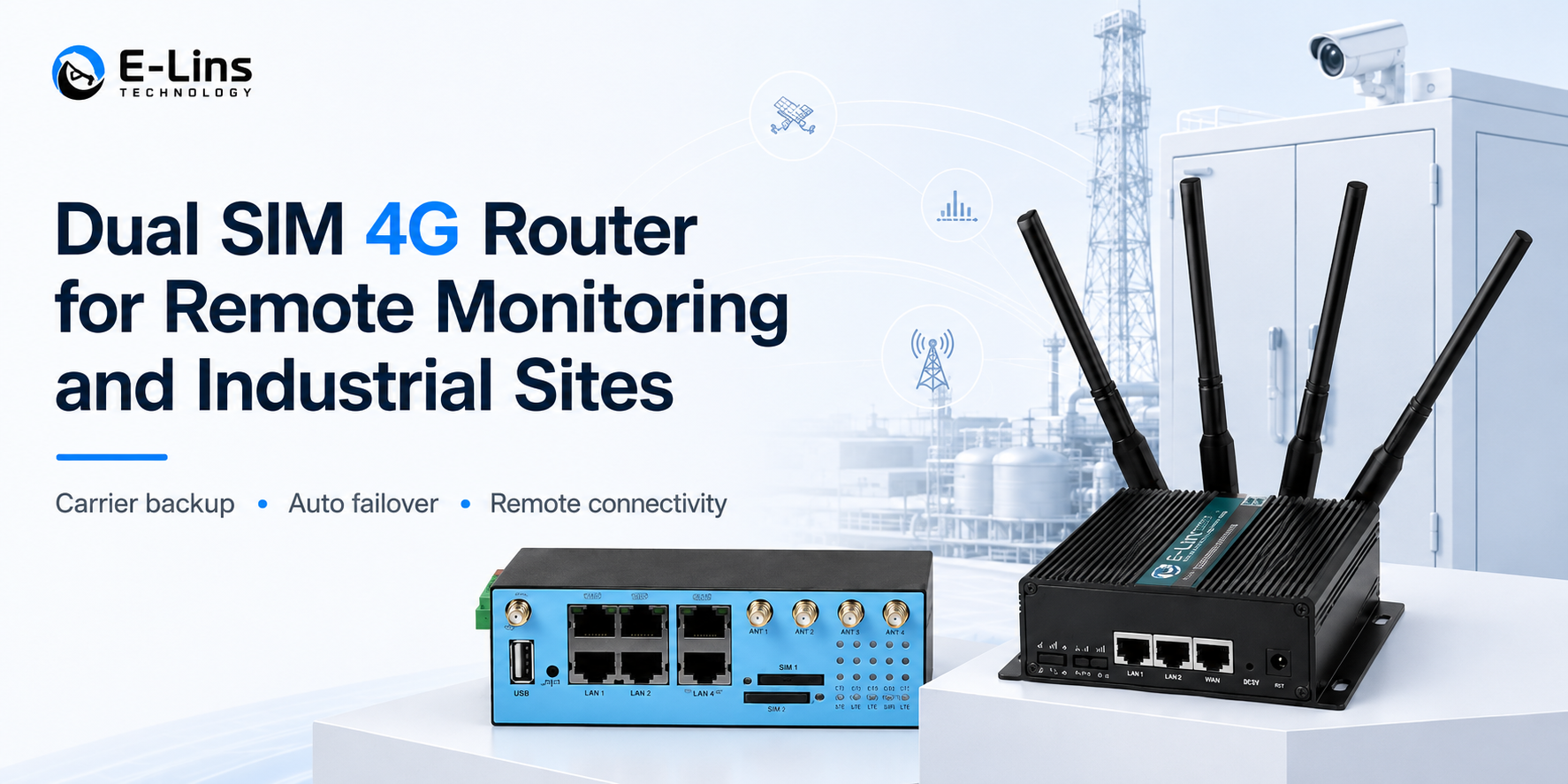
A dual SIM 4G router is often selected for remote industrial sites where one unstable carrier connection can stop monitoring, alarms, or remote maintenance. For buyers comparing a dual SIM 4G router, the real question is not only whether the router has two SIM slots, but whether it can keep the site reachable when one carrier path fails. A CCTV camera may stop uploading. A pump station may become unreachable. A power cabinet may lose telemetry during carrier maintenance. Therefore, an industrial 4G Router should do more than connect one SIM card to the internet. It should support carrier backup, automatic recovery, secure access, and practical field maintenance when no engineer is standing beside the cabinet.
This guide explains how a dual SIM 4G router supports remote monitoring, what dual-SIM cellular routing can and cannot solve, and which configuration details matter before deployment.
What Is a Dual SIM 4G Router for Industrial Sites?
A dual SIM 4G router for industrial sites is a cellular networking device with two SIM card slots. However, the real value is not the slot count alone. The value comes from SIM priority, carrier redundancy, failover rules, keepalive detection, and remote recovery.
In a typical remote site, one SIM works as the primary connection. Meanwhile, the second SIM stays available as a backup path. If the primary carrier loses service, fails a connection check, or becomes unstable, the router can switch to the backup SIM according to its configuration.
Therefore, this type of router is useful in unattended cabinets, remote cameras, solar sites, pump stations, traffic systems, and industrial parks. It helps reduce the risk of complete site disconnection caused by one mobile operator.
Dual SIM Does Not Mean Double Speed
Dual SIM should not be confused with speed bonding. In most industrial failover deployments, the router uses one cellular path as the active connection and keeps the other path ready for backup.
As a result, dual-SIM routing mainly improves availability planning. It does not automatically double upload speed for CCTV video, PLC access, or cloud telemetry. Actual performance still depends on signal quality, carrier coverage, antenna placement, APN settings, data plan policy, and network congestion.
For this reason, a Dual SIM 4G Router should be selected as a backup and recovery tool first. Bandwidth aggregation should only be considered when the hardware, carrier plan, and network design clearly support that mode.
How Carrier Failover Works in Remote Sites
In a dual SIM 4G router, carrier failover usually starts with a preferred SIM. The router keeps that SIM online while checking whether the path can still reach the internet, a VPN server, or a defined host.
However, signal registration alone is not enough. A SIM may still show network service while real data traffic fails. Therefore, industrial routers often use ping checks, DNS tests, ICMP detection, or keepalive rules to decide whether the link is usable.
When several checks fail, the router can switch to the backup SIM. Afterward, some projects stay on the backup carrier until manual review. Others switch back to the primary SIM after the first carrier becomes stable again.
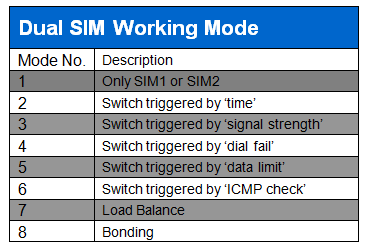
Failover Planning
Failover logic should match the application.
For CCTV, switching too slowly may interrupt video review. For sensor telemetry, a longer retry period may be acceptable. Therefore, failover timing should balance recovery speed, false switching, data plan cost, and VPN session behavior.
View Router DetailsKey Features to Check Before Selection
A second SIM slot does not define the whole router. Instead, procurement should review the complete field network before choosing a dual SIM 4G router. The following features often decide whether the site remains manageable after deployment.
1. Auto Failover and SIM Priority
First, the router should allow clear SIM priority settings. The main SIM, backup SIM, failover trigger, retry count, and failback policy should match the project requirement.
For example, a pump station may need fast recovery. Meanwhile, a weather station may tolerate a longer reconnection window. Therefore, failover settings should not be copied blindly across different sites.
2. Keepalive, Watchdog, and Remote Reboot
Next, keepalive and watchdog functions support automatic recovery. A keepalive check verifies whether the router can reach a target address. A watchdog can restart the connection or reboot the device when recovery fails.
However, reboot rules should be conservative. Too many restarts can interrupt normal service. A staged recovery path is usually better: reconnect first, switch SIM second, and reboot only when needed.
3. VPN and Secure Remote Access
Remote access is often as important as internet access. Therefore, VPN support should be checked early when a dual SIM 4G router will connect PLCs, NVRs, meters, or controllers. Common industrial needs may include IPsec, OpenVPN, L2TP, GRE, WireGuard, or other secure tunnel options.
At the same time, SIM and APN policy matters. Some mobile plans use CGNAT, which can block direct inbound access. In that case, a VPN design or private APN may be needed for PLCs, NVRs, meters, or controllers.
For broader mobile IoT planning, the GSMA Mobile IoT resources can be used as an external reference when teams review cellular deployment, roaming, and connected-device requirements.
4. LAN, WAN, Serial Port, and Field Interfaces
Industrial cabinets often include more than one device. Therefore, LAN ports, WAN mode, DHCP, NAT, firewall rules, and static routes should be reviewed together.
In addition, many field systems still rely on RS232, RS485, Modbus RTU, or serial-to-IP communication. If legacy equipment is part of the site, interface planning should start from the device list before selecting the router.
Remote Monitoring Applications
A dual SIM 4G router is most valuable when a site is hard to reach, expensive to service, or expected to run without local staff. Therefore, the strongest use cases often involve unattended infrastructure.
CCTV and Security
Cameras, NVRs, alarms, and access control systems may need stable upload and secure remote access. However, video bitrate and data plans must be planned carefully.
Energy and Power Sites
Solar farms, substations, and power cabinets often need telemetry, alarms, and remote diagnostics. In addition, surge protection and grounding deserve attention.
Pump Stations
Water, irrigation, and wastewater sites may connect PLCs, flow meters, pressure sensors, and alarm devices through cellular VPN access.
Traffic and Roadside
Traffic cabinets, roadside cameras, parking systems, and message signs may require compact installation, stable power, and remote maintenance.
Industrial Router Options for Dual-SIM Projects
This article should not replace a product page. However, two related router options can help connect the dual SIM 4G router selection logic with actual E-Lins product paths.

H900t Industrial 4G LTE Router
Suitable for projects that need dual-SIM LTE access, Gigabit RJ45, PoE-related deployment options, USB, and industrial remote networking.
View Product
H750tt LTE IoT Router
Suitable for IoT and M2M sites that need Ethernet, Wi-Fi, RS232 or RS485 options, VPN access, and remote industrial equipment communication.
View ProductDual SIM 4G Router vs 5G Router
Industrial 4G remains practical for many remote monitoring sites. Sensor data, PLC status, alarms, small files, and moderate camera uploads often work well when LTE coverage is strong and antennas are installed properly.
However, a 5G Router may be worth evaluating when the site needs higher bandwidth, lower latency, more cameras, edge computing, or longer capacity planning. Local 5G coverage and data plan availability should be confirmed before final selection.
In addition, many 5G deployments still need LTE fallback. Therefore, the decision should come from the application requirement, available carrier network, site environment, budget, and expected lifecycle.
Buying Checklist for Remote Industrial Sites
Before selecting a dual SIM 4G router, the project requirement should be converted into a clear technical checklist. This helps avoid wrong models, weak remote access, and repeated field visits.
Carrier and SIM
Confirm carrier coverage, SIM plan, APN, static IP, private APN, roaming policy, and local LTE bands.
Failover Rules
Review SIM priority, keepalive target, retry count, reconnect delay, and automatic failback behavior.
Security
Plan VPN, firewall rules, access control, password policy, and remote management permissions.
Interfaces
Check LAN, WAN, Wi-Fi, RS232, RS485, antenna connectors, and local device communication needs.
Installation
Review power input, cabinet space, DIN rail or wall mounting, grounding, temperature, and antenna position.
Lifecycle
Consider firmware control, spare units, configuration backup, SIM lifecycle, and long-term carrier changes.
Therefore, a field-ready design should include router selection, SIM planning, antenna placement, VPN design, power protection, and maintenance workflow.
Common Deployment Mistakes
- Using two SIM cards from the same carrier: This may help with one SIM plan issue, but it does not fully reduce carrier network risk.
- Testing only in the office: The final cabinet, antenna position, and local tower conditions can be very different from an indoor test.
- Ignoring APN and CGNAT: Some SIM plans cannot support direct inbound access without VPN or private APN planning.
- Treating antenna placement as an accessory: Poor RF installation can make both carriers perform badly, even when the router is correctly configured.
Extended Reading and Related Product Paths
For a complete selection path, the following pages help compare router categories, product options, and contact routes without turning this guide into a product page.
Contact E-Lins for Industrial Cellular Router Selection
As a 4G router manufacturer, E-Lins supports industrial cellular networking requirements for IoT, M2M, remote monitoring, and unattended field communication.
For a more accurate recommendation, prepare the country, carrier coverage, SIM and APN details, site device list, remote access method, power input, antenna position, and installation environment. With these details, E-Lins can help review whether 4G, dual-SIM backup, 5G, VPN, serial interface, or specific mounting options are more suitable.
Contact E-LinsFAQ
Frequently Asked Questions
Summary: Plan for Recovery, Not Just Connection
Remote industrial networking should focus on recovery. A site may connect well during installation, but the real test starts after weeks or months of unattended operation.
A dual SIM 4G router can reduce single-carrier risk when failover, APN, VPN, antenna, power, and remote management are configured correctly. However, it should not be treated as a speed booster or a guarantee of perfect uptime.
- Action 1: Test both carriers at the real cabinet or antenna position before final deployment.
- Action 2: Define failover, VPN, APN, remote reboot, power, and antenna requirements before purchase.
- Action 3: Share site details with E-Lins so the router configuration can match the real industrial application.