
How RedCap Routers Are Transforming Commercial IoT Deployments

For commercial IoT—think digital signage, EV charging stations, and smart retail—connectivity needs are very specific. You don’t need the millisecond latency of autonomous driving, but you do need long-term reliability, moderate throughput, and a device cost that makes business sense. Until recently, the cellular world offered a binary choice: expensive, high-power 5G or legacy LTE with an expiration date.
5G RedCap router has emerged as the “Goldilocks” solution for this massive market segment. By offering a streamlined version of 5G, these routers unlock new deployment scenarios previously constrained by power budgets or hardware costs.

1)Understanding the 5G RedCap Value Proposition for Business
The “Right-Sized” Performance Metric
For commercial applications, “performance” isn’t just about speed; it’s about the balance of features. 5G RedCap operates on 5G Standalone (SA) networks, providing a clear path forward as operators progressively refarm 4G spectrum.
- Throughput: Peak downlink speeds of 226 Mbps (theoretical).
- Latency: 5G-level low latency for responsive applications.
- Complexity: Requires only two antennas, simplifying installation in compact enclosures.
2) Transforming Key Commercial Verticals
1. Smart Retail and Digital Signage
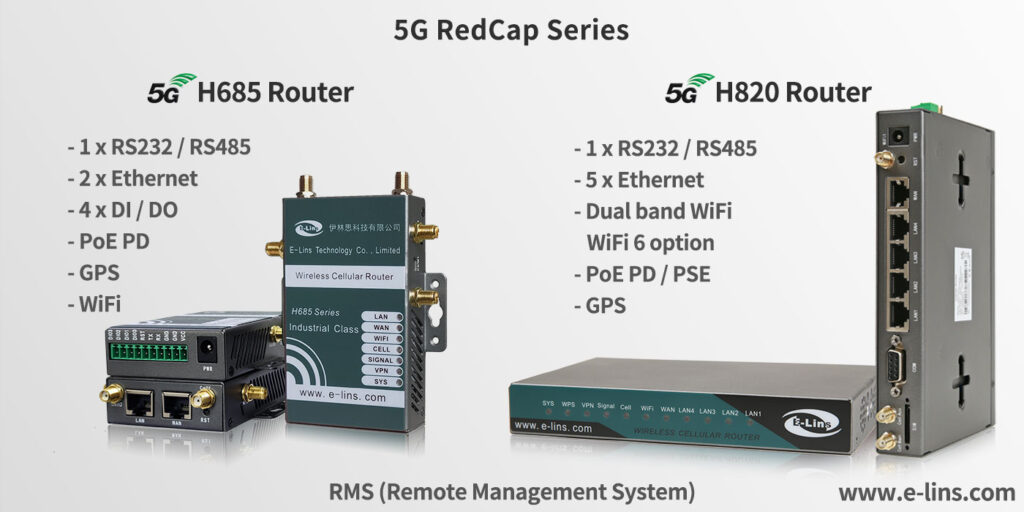
Digital signage networks require reliable, always-on connectivity to push dynamic content. The E-Lins H685frc, with its semi-rugged metal housing (IP30) and compact design, is tailored for these environments. It mounts easily behind displays or in kiosks, using dual Ethernet ports to connect the media player and POS system while the 5G uplink provides WAN connectivity.
2. EV Charging Infrastructure
As electric vehicle chargers proliferate, they need always-on connectivity for payment processing and remote diagnostics. Installing fixed-line broadband at every charger is logistically impossible. 5G RedCap routers provide the perfect backhaul—they are more reliable than consumer 4G in dense urban areas and are built to handle the temperature swings inside charging stations.
3. Smart Agriculture and Distributed Assets
In agriculture, monitoring soil conditions or irrigation pumps often means deploying devices in remote, off-grid locations. The ultra-low idle power of RedCap (around 840 mW for the H685frc) allows these routers to run on battery or solar power for extended periods, sending back crucial data from the field without the need for high-maintenance power sources.
3) The Cloud Management Revolution
Deploying hundreds of routers across retail chains or city-wide infrastructure requires robust management tools.
1. Zero-Touch Deployment and Remote Troubleshooting
Modern RedCap routers ship with cloud management subscriptions (like E-Lins Complete). This allows IT managers to configure devices centrally, push firmware updates over the air, and, crucially, perform remote troubleshooting. Support teams can securely retrieve diagnostic packages from deployed devices without sending a technician on-site, significantly reducing operational costs.
2. Multi-Profile SIM Intelligence
Managing carrier relationships across state lines or country borders is a headache. Multi-profile SIM support, integrated natively in platforms like E-Lins OS, automates carrier switching. The router detects when the active SIM profile changes and adjusts radio settings automatically, ensuring optimal coverage without manual intervention.
4) FAQ – Commercial 5G RedCap Routers
Q1: I run a digital signage network. Why should I choose a 5G RedCap router over a 4G router?
A: Longevity. Mobile network operators (MNOs) are gradually refarming 4G spectrum for 5G. A 4G-only device may lose connectivity or performance over the next 3-5 years. A 5G RedCap router (like the H685frc) ensures your hardware remains compatible with evolving network infrastructure, protecting your capital investment.
Q2: The specifications mention “sub-1W” power consumption. Why does this matter for my EV charging station?
A: Heat management and reliability. Commercial routers are often sealed inside cabinets with no active cooling. Lower power consumption (idle: 840 mW) means less heat generation, which extends the lifespan of the electronics and reduces the risk of thermal shutdown in the summer. It also allows the charger to function normally even if the primary grid power fluctuates, as it can rely on backup batteries longer.
Q3: How difficult is it to install these routers? Do I need a specialized technician?
A: Installation is designed to be straightforward. The two-antenna design of 5G RedCap simplifies the physical setup compared to 4×4 MIMO systems. Furthermore, with cloud-based management tools, the “configuration” can be done centrally. A local technician simply needs to power on the device; the IT team can then adopt and configure it remotely via the cloud.
Q4: Is edge computing possible on commercial RedCap routers?
A: Yes. Many of the new generation routers, including the H685frc, support edge computing via containerized applications (e.g., Docker). This allows you to run lightweight analytics or protocol translation directly on the router, reducing the amount of data that needs to be sent to the cloud.
Are you source an industrial 5G RedCap router? E-Lins will be an excellent choice for you. Founded since 1999, specialized on manufacturing industrial 5G RedCap routers.